
Every episode, in writing
The digest takes five minutes. Full transcripts include timecodes.
When AI Customer Service Bots Get Possessed: Use the Same AI to Break Into Your Own House First
After customer service bots in big brands' private channels were hijacked, this episode moves from what counts as a vulnerability to two serious PHP flaws, then to why AI-built products leave their doors unlocked, and lands on three prompts that have AI make a checklist, play the attacker, and watch the patches, so we can break into our own house first.

What's It to You If Someone Else Gets Fleeced: Do Not Fail to Promote Good, or Stop Evil, Because It Is Small
“Don't meddle in other people's karma” mostly concerns other people's private affairs, but a small wrong that fouls a space everyone shares is not just one person's karma. The AI industry's bubble and scams were built up precisely because no one spoke up. The point is to withhold likes and shares from exaggerated content, report it when it comes up, and actively promote the people who tell the truth.

Six Skills That Give AI Taste: Methods Can Be Installed, Taste Has to Be Your Own
I read through the twenty-odd aesthetics and design skills among the top 600 on the install leaderboard, picked six, and walk through which one to use at each step of building a page from start to finish. The takeaway is that skills can bring in design methods, but the taste for what suits your own business is still yours to supply.

Why Should AI Give Me Life Advice? Turning a Book's Principles into Steps I Can Actually Take
I turned the viral Cost-Effective Life Guide into a skill called Life Checkup. Claude Code first asks eight multiple-choice questions about my family situation, then combines the book with what it knows about me, and uses Tiny Habits (the Fogg Behavior Model) to break the advice into small habits—turning the book's principles into next steps I can actually take.

What Do Companies with $10 Million in Revenue per Head Get Right? The Same Five Things, and I Do All of Them
Twenty-three AI agents went through cases from more than a hundred companies and individuals. The service companies that never took investment and lead on per-head figures all get the same five things right — selling services rather than tools, value-based pricing, serving only clients with high ability to pay, owned traffic, and few people with no idle staff. I do all five, and have more or less reached project freedom.

We Hired a Top Programmer and Put Them on Slide Decks: Think Bigger Means Revisiting What Was Once Out of Reach
Agents like Claude Code and Codex are the world's top programmers, yet every day we have them making slide decks and sending emails. Starting from experiments and usage reports, this episode lands on think bigger—looking back at the things we couldn't afford to touch because there were no people, no money, no time.

Why an AI Venture Shouldn't Be Love at First Sight: Build Only What Can Be Productized and Iterated On Indefinitely
The people around me who made their first pot of money mostly found one profitable loop and kept replicating it, doing the same thing a hundred times without getting bored, while those of us who tire of the old have to find work we never tire of. Starting from my cloud-based Claude Code and an AI short drama project, the takeaway is that this year we only build things that can be productized and keep being iterated on.

Is Feishu the Best Choice for the AI Era? A Good Solution Today, Definitely Not the Best One Long-Term
On September 15, Feishu declared that Feishu plus Doubao Work is the best choice for work in the AI era. This episode starts from enterprises' underlying need for private, customized systems, looks at why platform ecosystems emerged in the first place, and explains why, once customization gets cheap enough, Feishu, a good solution today, is definitely not the best one in the long run.

The AI One-Person Company Community Is a False Premise: What an OPC Needs Isn't Another OPC, It's Small and Medium-Sized Businesses
Starting from an in-person session in Chongli with nine one-person companies, this episode explains why the AI OPC community and OPT are false premises — with no division of labor everyone is a competitor, and AI has already filled in the puzzle. The conclusion is that an OPC needs small and medium-sized businesses that keep bringing work, and many-to-many is healthier.

Why Seeing the Opportunity Didn't Make Money: How Much You Earn Is Decided by the Last Two Steps
People who know technology and live by their skills rely too heavily on ability to solve problems. Starting from building a cloud Claude Code in February without ever thinking about monetizing it, this episode uses four stages — discovering, creating, replicating, and monetizing value — to break down short videos, comic dramas, Pinqieqie, and Doubao Work seats. The takeaway: how much you earn is decided by the last two steps.

Will Using CC on the Road Get You Banned: The Egress IP Never Changes
A filmed look at a mobile setup on a high-speed train — a Pad plus an eighteen-inch touchscreen, remoting into a cloud lightweight server to run CC. The egress IP stays fixed, so your location jumping around won't get you flagged by risk control.

Can You Trust What AI Influencers Say? Use Common Sense, Don't Believe Everything
A well-known AI influencer claims to spend hundreds of thousands of dollars monthly on tokens, but they won't tell you about model pricing gaps, cache-hit discounts, or subscription equivalences — the numbers are deliberately inflated for traffic and course sales, so use common sense and don't believe everything

What Is AI-Native Coaching: It's Not the Product You Keep—It's the Ability to Iterate
Business owners who want to bring AI into their companies face three dead ends—hiring developers, video courses, and traditional classes—so I rebuilt the model as a twelve-day online challenge where owners work with their own AI, my AI monitors everything, and what they take home is not a finished product but the ability to iterate.

Six Months with AI Destroyed Me: It Destroyed the Old Me Who Managed People and Pushed Projects
After six months with CC, old passions — flight game rankings, concerts, photography — lost their pull. Nothing compares to building a product with AI. One person now finishes in less than a day what a team took months to do, and the real ceiling turns out to be your own judgment and insight.

Why AI Isn't Making You Money: It Grows One Order at a Time
Most people aren't failing to make money with AI — they just look down on the money. Small orders on second-hand marketplaces are modest, but they pay today. Those who pass on the small money end up chasing uncertain bets or trying to build the next big product. The sequence should be reversed — find the business first, then use AI to accelerate and scale. Amplify zero, and you still get zero.

Has YC's Investment Trend Really Changed: Our Odds Went Down — but So Did Our Need
The Chinese internet says experienced founders are in demand again, but YC's latest data tells a different story — nearly sixty percent of their newest funded founders are under twenty-five, and the real surprise is who went missing: the twenty-five-to-twenty-nine cohort, who may simply not need incubation anymore.

Must AI Efficiency Lead to Layoffs? Figure Out the People and Money First
When AI works well in mature workflows, about 60% of roles can be replaced. Employees resist because sharing expertise genuinely makes them worse off. Leaders need to redesign incentives and avoid hasty cuts. 70% of AI success comes down to people and process, not technology.

Can 10,000 Followers Sustain an OPC: Attention Scales, Trust Doesn't
Everyone says you have to go viral. But have you done the math on how many people you actually need? Ad revenue requires hundreds of thousands of viewers; service work only needs a handful of the right ones. What matters isn't follower count—it's whether those followers spend money to save time or spend time to save money. Attention can be wholesaled. Trust can't.

50 CC Accounts Banned at 3 AM: After the Damage, Let's Talk About Trust
An official update silently broke the rule blocking CC's default upload behavior — 50 accounts banned overnight, every environment rebuilt from scratch. Yet even after a loss this big, clients volunteered to pay more. Episode 100: on the cost of defaults, and the trust that comes from sincere delivery.

Will AI Kill Our Creativity: The Lock Is One You Put on Yourself
DeepSeek's core engineer Liu Shengyu says AI isn't taking away your livelihood — it's taking away the work you loved. When everyone relies on AI for answers, your company's ceiling becomes the model's ceiling. Nobody's stopping you; the lock is self-imposed. Think for five minutes before you ask, and reason from first principles to find the path AI can't.

Why Company-Wide AI Training Doesn't Work: Bet on the Self-Starters
Companies pour money into training everyone on AI, but what they teach is exactly the layer AI already handles. The truly scarce qualities—responsibility, intrinsic drive, and judgment—can't be taught. Instead of spreading the budget thin, give the best tools, data access, and real scenarios to the few who are already using AI on their own. One person's salary can double the output of ten self-starters.

A Good PM Feels the Pea: Don't Lower Your Standards When Building with AI
From a list of things that feel wrong in a product to the idea of turning a course into a game: clarify where you are and where you want to go before choosing the route. Years of industry experience can help you notice what needs to change.

I Registered a US Company Without Speaking English — AI Walked Me Through It
A step-by-step account of registering a US company from China with zero agency help. Phone calls, physical mail, faxes — all navigated with AI as a real-time consultant, not a search engine.

Best Deal at $200? That's Not How This Math Works
OpenAI just paused new subscriptions to its $200 Pro tier with no announcement or timeline, while Anthropic is cutting Claude Code's weekly limits next Monday — both citing compute constraints. But the real story isn't about supply. Every consumer-tier conversation defaults into model training, retained up to five years, and the difference between a settings toggle and a commercial contract is the difference between trust-me and prove-it — which matters the moment a client's trade secrets hit your desk.

Do You Really Need Apple's Foldable: It's Only a Finger Wider
Seven years into foldable phones, small foldables hold their ground — but this year's wide foldables are only about a finger wider than a Pro Max when unfolded, with virtually no benefit beyond watching shows. Rather than paying the premium, wait for the wide slab phones at a quarter of the price, or just go try one in the store first.

Claude Code Has Over Fifty Settings — How Many Have You Touched?
Claude Code ships with over fifty configuration settings that most users never open after installation. These control how the AI communicates, how much autonomy it takes, and how long it waits when you don't reply — and some defaults quietly work against you. A purpose-built skill reads your actual usage patterns, then walks you through each setting in a few minutes, turning a documentation deep-dive into a simple conversation.

You Don't Need to Learn AI — But the People Teaching It Deserve a Pop Quiz
Most AI instructors run on pure information arbitrage — no shipped projects, no real business experience, just recycled prompts dressed up as expertise. The real unlock is not studying AI but getting your hands on the best tools and thinking for yourself. For founders and executives who can make their own calls, that distinction changes everything.

Building AI Products—It's Not About the Tech
Using voice input as a case study, this piece breaks down three problems that make big-company AI products frustrating to use—even though their underlying tech is perfectly fine. None of the fixes require a stronger model. Every one of them comes down to whether someone thought carefully about where users actually get stuck. The best tech gets pushed forward by genius and resources; the best product insight is a skill you can train yourself.

Don't Brute-Force Your Way Through AI—Turn It into a Flowchart
A skill is really just an SOP written for AI—a description of a business process. Since it's a process, you can extract its core information with a logic flowchart and lay out the loop-and-branch logic visually. Keeping up with new AI tech isn't about scrolling the-sky-is-falling headlines; it's about digging into official documentation and even source code, then abstracting them into flowcharts. Attach a Q&A bot to the diagram, feed it your requirements, let it iterate the system from the process framework, and hand it to CC for rapid iterative development on top of existing code. In the AI era, what matters most is how you think about it.

One-Hour Livestream, 68 Clips Out
PinQieQie: a video clip-extraction tool built for founder IPs. One hour of raw footage automatically yields 68 clips, with only 13% trimmed.

Not a Programmer—So Why Can I Build AI Products
During a live class, Gary asked point-blank: you're not a programmer, so how do you systematically build innovative AI products? After genuinely thinking it over, Zhang Pinpin traced his answer to four abilities—aesthetics and taste honed through a decade-plus of art training, a user-centered mindset rooted in information architecture and interaction design, a temperament that embraces Sisyphean total rebuilds, and an intuition for complex systems picked up from years of obsessive gaming. The honest conclusion: building AI products today doesn't require writing code, but it absolutely demands hard work—at minimum, learning every relevant technical concept well enough to understand what the AI is saying and give it accurate feedback.

Don't Use a Cannon on a Mosquito: The Five Levels of AI in a Business, and Which One You Actually Need
The most common waste in enterprise AI is reaching for the heaviest tool first—fine-tuning a model when the job doesn't call for it. Andrew Ng has pointed out that 75% of teams doing fine-tuning don't actually need it. Walking through five levels of AI capability—large language models, chatbots, workflows, Skills, and Agents—each has its own sweet spot, and earlier levels don't become obsolete just because later ones exist. For the same quality of output, the real question for a business leader is which level fits the job—factoring in cost, efficiency, and the nature of the work.

The Stronger Model Has Half the Users—The Underrated Power of Persona
Doubao has 380 million monthly active users. Qwen has 160 million. Both are free. Qwen leads on most benchmarks. So why the gap? Not money, not distribution—it comes down to what Zhang Pinpin calls "persona": the relationship a product sets up with its user. Doubao greets you like a friend; Qwen greets you like a search bar. But in the enterprise market, persona does not close deals. Three players are now fighting for AI-powered office tools, and the real battleground is the vast majority who have never used AI at work.

You Can Copy the Interface, Not the Craft
In the AI era you can clone an app and get to 70 out of 100—but what you've copied is the shell, not the substance. Take auto-editing: just the breath-gap detection needs three models running in sequence—recognition, revision, auditing—on top of vocal isolation, noise reduction, loudness normalization, and waveform-curvature analysis that lands cut points within 0.02 seconds. None of that is visible in the UI. Layer in constantly iterated industry know-how—what structures lift completion rate, what phrasing moves product—and you have something nobody can reverse-engineer from a screenshot. An 80-out-of-100 product has zero value in a market full of 80s.

Go Deep on a Capability Module, Not an Industry: Building a Communication Tool for the Deaf in Ten-Odd Minutes
During an offline class in Hangzhou, a student spotted a real pain point: deaf people have no good way to hold a face-to-face conversation with hearing people. Zhang Pinpin reused the speech-recognition framework he'd already built for a voice input tool and had a working website up in a little over ten minutes. The takeaway: you don't have to go vertical in one industry—get one capability module to 90-plus quality and it can be reused across industries and projects instantly.

Your Core Expertise Shouldn't Be Packaged Into an AI Agent for Sale
The moment business owners learn AI, they want to distill decades of industry know-how into an agent and charge clients for it. That is the worst move you can make. A self-built or hastily outsourced agent tops out around a 70–80 percent quality level, tanks client perception of your service, and anchors their price expectation to "AI-generated, therefore cheap." The smart play is the opposite: polish the tooling for your own team, keep the client-facing layer human, deliver the emotional value that matters, and use automation strictly to boost headcount efficiency and delivery capacity.

My product grew itself — I just tap confirm on my phone
If you're a boss using AI, don't hire an assistant — a manager's job is to observe, judge and decide, not to do the delivery. Zhang Pinpin turned most of his commercial products into "self-iterating" ones: instead of open-sourcing the code, he opens a user feedback panel. Claude Code parses each request, ranks it against his roadmap, writes the code but does not ship it — it waits for him to read the report on his phone and tap confirm, then hot-ships and replies to the user who asked. The cloud version of Claude Code shipped 642 updates in 33 days; about a third came from his own roadmap, the rest from user feedback and the AI's daily patrol over analytics events. The product wasn't planned. It was fed.

Why FDE Never Took Off — And Why It Might Be the Wrong Question Entirely
The FDE concept has been around for over 20 years, rebranded from "customer success" and now hyped as a hot AI-era career. Zhang Pinpin argues it is fundamentally a false framing: enterprise AI transformation is an organizational problem, not a technical one, and AI skills are merely the entry-level requirement. The few people doing it well are industry veterans with cross-disciplinary backgrounds and deep executive trust. Instead of taking courses, aspiring practitioners should chase real projects and learn by delivering.

Why Your "Remove AI Tone" Skill Barely Works
Removing AI tone isn't a single-skill fix. Even after layering formatting constraints, speech-habit mimicry, and structural DNA, the underlying model and runtime harness still dominate output quality. Claude Code's Cowork mode ships with a text-optimized system prompt; Code mode opens with an engineer persona — no skill you bolt on top can fully override that. The real workflow splits into two stages: get the logic and arguments right first, then polish tone with a custom output style. This episode itself proved the point — a digital-avatar version sounded human but explained nothing, so I re-shot the whole thing on camera.

Don't have AI build you a horse-drawn carriage
Most people get the first step of AI research backwards. They hunt for prompts, pile their own requirements onto the model, fan out a swarm of agents, burn a pile of tokens—and what comes back is missing perspectives, full of hallucinations, or a heap of technically-correct platitudes. You're holding a brush that can create anything, and you're asking it for a carriage—then deciding for it that the carriage needs twelve wheels and twenty horses. Here's the other way round: connect it to the best sources, have it find the best practice first, and tell it the need behind the need.

One person, one agent: my AI community dashboard
Running a community group has probably never been this easy. Over four hundred people, grown purely organically, close to half of them active, 308 who started a conversation on their own, daily messages up from two-hundred-something to nearly five hundred—engagement, questions, and lead follow-up all handled by one agent. This episode walks through the framework. It does not hand over the source code: in the age of AI development, a framework you can learn from beats source code you'd only imitate.

The AI purchasing trap bosses keep falling into
Five clients told me they were on the official Claude Code. I checked: three were going through a relay, and two had a domestic Chinese model behind them. The trap isn't when it throws an error. It's when it throws nothing and just quietly gets worse—and no matter how steep the discount, your monthly token bill isn't necessarily lower. Sometimes it's higher than the official subscription.

Bosses who use AI don't lug a laptop around all day
This afternoon I'm meeting a few founders of AI companies and a CEO coach. Prepping for it didn't mean an afternoon at a desk reading up—I split my own views into several dimensions, had AI go collect the information for each one in parallel, added the projects I've been working on, and folded all of it into a single web page. Then, on my way out the door, one spoken sentence sent it over. The real shift isn't being able to use AI. It's that none of this is tied to a desk anymore.

The model has no memory at all: the gap between you and everyone else is in the harness
Beginners can't picture what a harness is. The word literally means horse tack—the model is the horse, you're the rider, and the saddle, stirrups and reins exist for exactly one purpose: so the two of you work together more smoothly. And on the horse's side there's a precondition most people miss: no matter the parameter count, the model has no memory. None at all. Every new conversation is the female lead in 50 First Dates waking up. So the gap between one person and another using AI comes down largely to how good the harness is.

Playing with AI—have you actually made money? Three paths, and the precondition most people skip
An uncomfortable question. There are really only three ways to make money with AI—cut cost, copy, or take the business apart and rebuild it. This post breaks down where each one gets hard and which one fits a company versus one person. But what matters more is the precondition sitting under all three: you have to be making money already. Everything you learn should make an already-profitable method faster, more scalable, more automated—not learning every new technology and installing every new skill you see.

WeChat Input Method quietly got much better: speech-to-text now punctuates, paragraphs and rewrites for you
One thing today: go download WeChat Input Method. Its speech-to-text just got a large-model upgrade—beyond raw accuracy, it strips filler words, adds punctuation and paragraph breaks, condenses long passages into bullet points, and straightens out sentences you garbled. It now holds up against Typeless and against the input method I built myself. This post has the official download links for every platform, which version the feature landed in, and how to trigger it on desktop.

AI edits the finished video: the whole pipeline, revealed
Fans have been asking for a while: how exactly does AI produce my daily short videos? This episode lays out the whole seven-step pipeline—topic selection, voice-DNA scripting, voiceover, digital human, covers and infographics, assembly, publishing. Two honest numbers: the AI grinds for one to two hours per video, and I won't pretend one click yields hundreds; a video costs tens of RMB, and you can push that down to a few RMB or up to a few hundred.

Don't use Obsidian for AI knowledge management: hand over all three jobs
I'm not here to call Obsidian worthless. I'll start with what it got right—and once I do, you'll see that the things it got right don't need Obsidian to do them. A note app sells three jobs. It bet right on storage, but that upside goes to the AI. Maintenance is something people simply cannot keep up. Viewing is the one reason it's still on your machine, and it's the job it does worst.

AI Stock Trading—Where Does the Data Actually Come From? From Zero Yuan to 39,000 a Year, I Tested Every Route
I tested every route for feeding stock market data to AI, verified every price against the vendor's own site, and built it into one comparison table. The three free sources hit the same stock and came back not a cent apart; for Hong Kong stocks, two letters in the symbol are the difference between a live price and one 22 minutes stale, and nothing raises an error. Three-layer architecture, the price ladder, three rules for using data, and the full comparison table available to download.

AI Takes Over Online Docs—You Don't Have to Be the Courier Anymore
Online docs solved collaboration between people, but the AI leg of that chain has always been broken. This episode connects it. AI builds the sheet and writes the content directly in Tencent Docs, I drop the link in a group chat, the client opens it inside WeChat and fills it in, and AI reads it back and keeps calculating. Plus two traps you must know about before you start.

Wiring QQ Mail into Claude Code—AI Manages Your Email, Clears the Junk, Even Fully Automates Invoice Expense Reports
I wired QQ Mail straight into CC. The whole process is three steps. Turn on IMAP in settings, scan a WeChat QR code to get a sixteen-character authorization code, and tell CC in plain language to manage your email—it writes its own tooling and you install nothing. Once it's connected, one sentence has it scan the inbox and sort everything into four categories, wipe out all the junk, write meeting emails into todos, and pull invoice attachments out and hand them to the expense report skill for a finished report. This episode also lays out the security boundary. An authorization code isn't your password, it can't get out of the mailbox, it lives locally, and you can void it whenever you want—you've given AI a key you can take back, not handed over your house.

The AI Barrel Paradox—The Era of Shoring Up Weaknesses Is Over
Harvard Business School and BCG ran an experiment with over 700 consultants, had them work with AI, and scored the output. The people at the bottom improved by more than 40%, the top performers by under 20%—AI leveled delivery quality out. This episode is my upgrade to the weakest-link theory. How long a plank is no longer matters. You collect the "breadth dividend" first, but that dividend has an expiration date. What's genuinely valuable is a strongest suit above 90 points, plus the communication skill to explain what you can do. The second half gives owners of small and mid-sized companies three ways to test a hire, and one question I don't have an answer to either. When knowledge labor is depreciating, what is the point of learning?

How My Hand-Rolled Claude Code Client Stays Completely Ban-Proof
Every few days someone asks me whether there's a foolproof way to guarantee Claude Code never gets your account banned. There is, actually—it's just a little inhumane and costs a fair bit extra, which is why I never talked about it. In this episode I walk through the whole approach, as far as I'm able to talk about it. A web-based Claude Code I built back in February and have iterated on several times since—chat window, interactive options, file system, todos, mailbox management—and it's multi-user, so each person on the team gets their own account and their own isolated server. Underneath it splits into five parts. A GUI console, an isolated cloud server per person, a tunnel server that maintains connections, a multi-domain mail server, and that residential exit I can't say too much about—so that to Anthropic, every account looks like one normal computer being used within the rules. Most people won't need this episode, but the thinking is worth a look.

Stop Hiring AI Celebrity Advisors—Here's What Bosses Should Actually Be Using AI For
A whole category has popped up aimed squarely at bosses—AI celebrity brain trusts, celebrity private board meetings, a little money and you get an advisory team of Buffett, Jobs, and Musk. I tried them all, and the verdict comes down to one word: playacting. At best it gives you some emotional comfort. Put a real business decision in front of it and it's lost, because what it lacks is a framework and the tools to do the analysis. This episode lays out how bosses should really use AI—turn a classic business analysis tool (the Lean Canvas) into an interactive agent you can re-run over and over, walk the nine boxes, hunt down the key assumption that kills the whole business if it's wrong, then verify that one thing at the lowest possible cost. Xiaomi did exactly this, shipping a free ROM first to see whether anyone would flash it, and only building phones once that passed. My open-source Lean Canvas coach skill is linked at the end.

Why Is the *Kung Fu Girls' Football* Marketing Push So Perfectly in Sync? I Used AI to Trace the Money Behind All 24 Production Companies
Not reviewing whether the film is any good—just chasing one question. Where does the money behind these two weeks of eerily synchronized marketing come from? I put my digital employee WorkBuddy on Kimi K3, wired in Qichacha's official data feed, and drilled through all 24 production companies in one afternoon to see how a public narrative gets steered.

Compute Will Eventually Cost More Than People: The Company Ledger Most Bosses Have Never Run
A 200-person team burns just under 100 million yuan a year on people; kitting every one of them out with top-tier AI costs about 1.7 million—under 2%. In Ramp's data, the most generous 1% of companies outspend an average company by more than 600x. Headcount is addition, compute is multiplication. Here's how the math works, and the three layers of getting results out of it.

Why Does AI Never Quite Get You? Because It's Missing Your Identity Core
We all want AI to understand us better—we tune prompts obsessively, add memory, write rules. But when it has to make a judgment or a choice on our behalf, it still often "doesn't get you." A Stanford experiment with 1052 people gave me a new angle. Defining a person with labels like education, age, occupation, and MBTI gets you 74% accuracy; a roughly two-hour deep interview that keeps digging until it forces out someone's real ordering of values builds an "identity core" model at 86%—a full 12 percentage points better, and people are already using it to build "digital avatars" of real consumers. I spent a few hours building a small app that reproduces that interview, saved the result as a Markdown file, and fed it to Codex / Claude Code. When it plans and chooses, it turns out to understand me better than I understand myself.

AI Deck Tools Are All Pointed the Wrong Way—What You Wanted Was Never an Editable PPTX
A contrarian call: every AI deck tool out there right now, without exception, has gone off course. They're pouring time and resources into "how do we generate a PPTX you can drag around and edit character by character," and some even market that as the selling point. But PPT stands for PowerPoint, and what it wants is to power the point—to use visuals during a talk to drive your argument home and move your audience. That's all. I've written decks for seventeen or eighteen years and served as an internal PPT instructor at Tencent, and I haven't opened deck software in almost a year. This episode takes my real production flow apart: have Claude Code interview me first, run multi-agent concurrent research, lock a black-on-white "big-type poster" web draft, then use the GPT Image 2 API to generate a full image-based deck in one consistent style. Work that used to take five to seven days now comes out in fifteen minutes on the way to the classroom.

A Master-Class Speech, Reproduced in Fifteen Minutes—Wiring Fable 5 into WorkBuddy to Build a Luo Zhenyu-Style Speech Expert
That "Luo Zhenyu speech" at the top of the video was AI-generated. I've been using AI to imitate Luo Zhenyu's delivery since 2023, and back then it took a sprawling agent architecture plus a corpus of his scripts to pull off. But on July 11, in an in-person class for Owl Academy's 19th cohort, I wired Fable 5 into Tencent WorkBuddy, used nothing but its built-in experts and skills, and built a Luo Zhenyu-style speech expert in fifteen-odd minutes of concurrent research and four or five turns of conversation—then generated eight minutes of speech audio on the spot. This episode takes the prompts apart turn by turn: multi-agent concurrent research, distilling a language fingerprint from 120,000 words of corpus, packaging the expert with Expert Manager, and adding a round for opening-hook design. Plus the safety guardrail voice cloning ran into: nobody gets to clone a celebrity's voice, so the final cut uses a preset voice. And where Chinese agents still lag—and where they've already pulled ahead.

See a Feature You Like? Have Your Own AI Learn It—Wiring Tencent Meeting into Claude Code
A small mental habit I use almost every day: when you see a good feature in someone else's software, don't sit there envying it and don't go switch tools—have the AI you already use learn that capability and wire it into your own workflow. This episode walks through a real run. I'm in Tencent Meeting every day and I rely on AI for my notes, so I had Claude Code assemble a multi-agent team to research what MCP options Tencent Meeting exposes. It compared the official MCP, the official open-source CLI, third-party MCPs, and the underlying Open API, picked the one that fits my personal Pro account, then walked me through authorization and connection step by step—SSHing into my local machine to run the commands, hitting an encoding trap and fixing it itself, working in half an hour. The process isn't the point. The thinking is.

Don't Blow Your Budget on a GPU—Top-Tier AI Tools Don't Need a Top-Tier Machine
The question I got most this week: to run Claude Code, Codex, and WorkBuddy, what kind of computer do I need? Most people are working from a big misconception—that top-tier AI tools demand a maxed-out machine with a flagship GPU, thirty to fifty thousand yuan down the drain. I bought a 3090, a 4090, and a pile of flagship laptops, then sold all of them, and my conclusion runs the other way: large-model inference happens in the cloud, and that local gaming GPU is close to wasted. Speccing an AI machine looks more like speccing a server. The money belongs in RAM and CPU cores, because they set how many windows you can keep open and how many sub-agents run in the background. This episode covers the buying logic, three machines worth getting, the traps that catch people most often, and the minimum VPS spec for running CC in the cloud.

If You Can Manage People, You Can Use AI—A Real Class-Prep Run with Claude Code as a Digital Employee
Everyone says to treat AI as a digital employee, but most people still use it like a search engine—tossing in a few keywords, never talking to it like a person. In this episode I take a real prep run for a 6-hour in-person workshop and show how I hand work to Claude Code the way I'd hand it to an employee. I dumped the pre-class survey and the interview transcripts on it and briefed the job in three sentences: here's the material, here's the purpose, here's the format and standard for delivery. It came back with a conclusions-first audience needs analysis, a one-page PDF, and an action list for me. That's not assistant work anymore, that's a partner. I also ran a side-by-side: the same Fable 5 wired into Tencent WorkBuddy. Then a word on the near future—the point where a company's compute costs pass its people costs.

Accounts Keep Getting Banned? I Turned My Life-Saving Account Security Setup into a Single-Machine Checklist
Lately the group chats in Beijing, Shanghai, Shenzhen, and Hangzhou have all seen officially subscribed Claude Code accounts banned pretty much across the board. Meanwhile the 26 accounts used by me and the CEOs and founders I coach haven't had a single incident—and plenty of those people fly around the world year-round. That isn't luck. Before I got this setup right, I had 15 accounts banned, local and remote, and spent an enormous amount of time studying and testing. This episode turns that hard-won experience into a single-machine checklist covering what to set, where to set it, and why: what to wipe from a machine after a ban (8 items), and how to configure things day to day so you don't get caught in the crossfire (28 items). To be clear up front: this isn't a crack and it doesn't guarantee you'll never be banned. Fundamentally it's about making a legitimately paying account present a consistent, real identity so risk systems don't hit it by mistake.

Too Many Files to Keep Up With? I Built a Local Service: Drop Them in a Folder, AI Renames, Sorts, and Indexes Them
In the AI era, my daily file output went from a handful to dozens or hundreds—web pages, proposals, audio, video, with bizarre names and every format under the sun. My old manual naming-and-filing system completely collapsed. So I built a local background service: it watches an inbox folder, and every time a file lands, a model reads its contents (documents and images go to Claude on subscription quota; audio and video go to Gemini), then renames it as date + type + summary, files it into the right folder, and builds an index layer for agents to read. Takes a dozen seconds. This episode walks through the whole design, focusing on the two retrieval middle layers—why humans want to look at web pages while agents want an index—and how to hang Claude Code scheduled jobs off it and distill your own identity core. The source is open.

Claude Code's Implicit Fingerprinting Is Real—but Being Flagged Isn't Being Banned
The story that Claude Code embeds implicit fingerprints in the timestamps of user conversations broke this week, and the creator crowd piled on with every interpretation imaginable—without one of them laying out the facts clearly. I verified it on my own machine: the fingerprinting is real, but it only marks connections going through third-party relays or third-party models. Official subscriptions and the official API don't get marked at all. And being flagged and being banned are two completely different things. This episode covers the mechanism, what the flagging keys off (the 147-relay list / whether you're a Chinese model company / your time zone), the real reasons behind the recent bans, and why the "they'll locate you via email and ban you" theory is people scaring themselves.

Generate Images on Your Subscription Quota: Have Claude Code Drive Codex, Pay Nothing in API Fees
Building decks, shipping demos, illustrating web pages—going through the API means paying per image, and it adds up fast. My last deck ran fifty or sixty pages and image generation alone was heading toward a few hundred yuan. But if you're already paying for a ChatGPT/Codex subscription, that quota already includes a built-in image tool. So I built a Claude Code skill: CC turns your ask into a structured prompt and drives codex to call the built-in GPT Image 2, spending subscription quota—no OPENAI_API_KEY, no API charges. This episode covers how to use it, what it can produce, where the limits are (standard definition not 4K, roughly 30 images a day, mediocre cutouts), and why I'd rather take the detour through CC than generate directly in Codex. The skill is fully open source and free.

What Companies Need Isn't an FDE—It's a TRC: Compute Deserves a Manager
FDEs (Forward Deployed Engineers—vendor engineers embedded inside client companies) are having a moment. OpenAI and Anthropic each spun up a company for exactly this in the same month, and job postings are up more than sevenfold in a year. But an FDE's paycheck comes from the AI company, which puts their loyalty on the vendor's side by design. For more than a year I've been doing the opposite thing, and I finally have a name for it—TRC, Token Resources Consultant: sitting on the company's side of the table and running compute and AI tools as a resource portfolio, covering tool selection, custom builds, configuration, planning, and governance. This episode lays out the difference between FDE and TRC, and why compute—the fourth factor of production—has reached the point where somebody needs to own it.

The Underrated /insights: Have Claude Code Run You a Monthly Retro
Nine out of ten people using Claude Code have never run this command; of those who have, almost nobody actually acts on what it says. It's called /insights—one slash and it runs, entirely locally, reading every conversation you've had with Claude Code over the past month and generating a usage insight report: where you're smoothest, where you get stuck every day, plus specific rules to write into your CLAUDE.md and habits to change. I ran it myself: 339 sessions and 894 hours in one month. The report's very first line got me—'you're not using Claude to write code, you're running a production line.' This episode covers what it is, how to use it, and where the value in that report actually sits.

GEO Is Multiplication, Not Addition: Product Substance Is the 1
This episode may offend a lot of people. GEO (Generative Engine Optimization) means getting your brand and product to show up in the answers AI generates on Doubao, DeepSeek and the rest—and it's already one of the most profitable lines of business for brand marketing agencies: low cost, high demand. But I want to voice the dissent: GEO is nowhere near as good as it looks. It's multiplication, not addition—it only amplifies when the product is genuinely strong and the brand is being discussed positively across the internet. It's the pile of zeros after the 1; it is not the 1. If product substance is weak, exposure is a disaster. At the end I run a live test with Claude Code: I had it compare 20-plus tablets against my requirements and it picked the Honor MagicPad 3 Pro—and in the comparison AI produced there was not one value proposition, not one slogan, no 'far ahead of the pack.' Just one thing: why this product fits my needs.

Don't Panic at Claude Code Errors: All 71 Error Codes + Three Ways to Triage
Red text in the terminal is nothing to panic about. Claude Code works by calling the Claude API, so almost every runtime error ultimately maps to an HTTP status code—a finite, classifiable set. I collected everything scattered across the official docs into one field guide: 71 errors in 8 categories, each broken down the same way—error code, original English text, Chinese translation, why it happens, how to fix it. Match your error and go. Plus the three triage moves I use most (hit Esc twice to rewind to a checkpoint / close the terminal and resume / have it write a to-do list and hand off to a new conversation). A wall of red text becomes a lookup table. The 401 that keeps showing up lately gets explained too: it just wants you to log in again, and a ban throws it too, so don't panic on sight.

Getting Ahead of Anthropic's Face Scans: A Three-Surface Backup Guide for Claude Code
Following up on yesterday's teaser, today is all about backing up your Claude Code data before a ban. First, calm down: July 8 is just the effective date of the new version of Anthropic's consumer privacy policy, and the official wording says identity verification applies to 'few use cases' and uses the word 'may'—it is not everyone getting face-scanned, and certainly not everyone who fails verification getting banned. The real risk is something else: mainland China, Hong Kong and Macau were never in the supported region, so an account ban can happen at any time. As someone who has had 15 accounts banned without losing a byte of data, let me make the one crucial distinction clear—Claude Code data comes in two kinds, local data (a ban can't take it) and cloud data (it dies with the account). How to back up all three surfaces, and how to pick up where you left off on a new account: just follow along.

Codex or Claude Code? Same Task, Head to Head, and It's Not Close
Too many people have been asking me which to pick, Codex or Claude Code, so today I'll answer head-on. My answer is simple: if you can reliably run official-subscription Claude Code, there's no reason to use Codex—at most, wire it in as a code-audit helper. To avoid talking in the abstract, I gave both agents the same config, the same skill, and the same prompt and had each produce a full-pipeline research report on auto-writing a WeChat Official Account article from content, auto-generating images, and pushing it into the drafts box. Codex's output looks decent at first glance, but next to what Claude Code produced, it's not close. More important: a lot of people think Claude Code is worse than Codex only because they got burned by a third-party-relay 'fake Claude Code.'

Docs, Decks, and Web Pages Into Talking Videos in One Click—VibeKnow, the One I Tested and Kept
A company building AI video asked me for a recommendation. I tried it for a while first—it turns a document, a deck, or even a web page into a publishable short video in one click, and it can narrate in my cloned voice. I think it has already gone past NotebookLM. This episode covers how to use it, the four modes, cost (the same video went from ¥200-300 down to about ¥10-20), and how to wire it into Claude Code so one sentence gets you a video. I took no extra fee and negotiated a viewer perk instead—sign up from the blog link and you get credits.

I Made AI Do the Scrolling for My "Feel for What Trends"—Auto-Finding Benchmark Accounts + Catching Hot Topics
Creator business runs on a 'feel for what trends'—the instinct for whether a piece of content will take off. It used to come from scrolling video five or six hours a day, and the price was brutal. This episode I handed the job to Claude Code: through a third-party data API it finds benchmark accounts for me every day and pulls the day's hot topics, ranked by 'virality rate' and filtered by tags. An operator's instinct for topic selection becomes a dashboard that runs on a schedule.

Using AI to Turn Data Into Insight You Read at a Glance—I Had Claude Code Analyze My Own Browsing History
Ever since I started living inside Claude Code, I barely open a browser. So I had it go through my Chrome history and put a number on how much less time I spend online—monthly time online dropped from roughly 150 hours to 83, daily average from 5.1 hours to 2.8, with a Sankey diagram showing where the time went. But the number isn't the point. Give AI a reasonably complete set of data and it will turn it into a clear analysis, and even dig out the reasons behind it.

Turn a Book Into an Agent—an AI Coach That Stays With You Until You Actually Do It
The best thing about reading is that it lets you befriend the smartest people who ever lived, across any distance in time. I built a skill that turns a book you own into an agent—not a "chat with your book" search box, but something that carries the book's methods, speaks in the author's own voice, and coaches you step by step until you actually do it, with every sentence traceable to a line in the book.
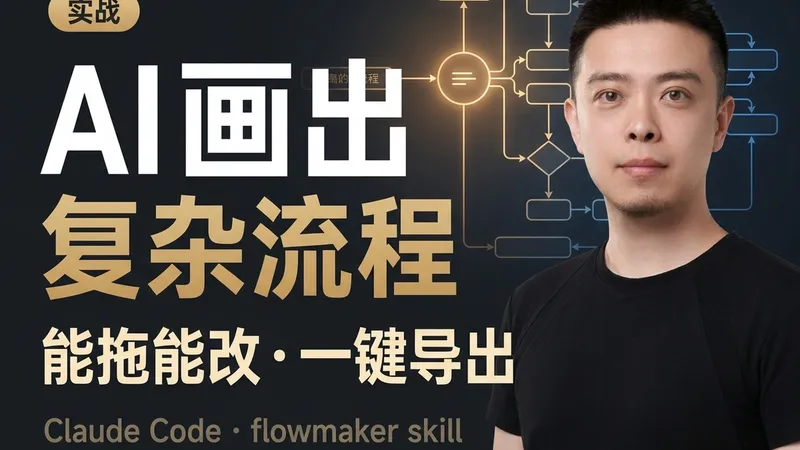
AI Draws Complex Flows—One Sentence to an Editable Web Flowchart
When you're walking a client or a colleague through a plan, complex steps and processes are impossible to explain in a few sentences. A flowchart is exactly what you need. So I built a Claude Code skill called flowmaker: describe a flow in one sentence and it generates an editable web flowchart—a single HTML file, zero backend, double-click to open. Nodes drag and rearrange, double-click to edit text, edges are editable, nodes expand for details, and one click exports a PNG. The skill is open source (MIT).

A Pile of Invoices, an AI-Built Expense Report—No More Filling Them In by Hand
Surely nobody is still filling in expense reports by hand at this point? I built a Claude Code skill called "baoxiao." Hand it a messy folder full of invoices (PDFs plus photos) and it renames and files them automatically, reads the contents, fills in your expense report template, attaches the Didi trip statements, separates commuting (personal income tax) from business travel expenses, and outputs a compliant, print-ready expense report PDF for finance, plus a duplicate-check ledger so you never claim the same invoice twice. Executives without an assistant, founders running their own company, board secretaries—hand the monthly expense-pasting chore to AI. The skill is open source (MIT).

Gaokao Application Choices with AI as Your Advisor—It Doesn't Fill the Form, It Builds You a Toolkit
Can AI help with gaokao (China's college entrance exam) application choices? Yes, but not the way you think. Don't have AI fill in the form—put its research ability to work guiding and safeguarding the whole process. I had Claude Code call Mythos Fable 5 and build a web-based "parent's application toolkit": three core mental models, the key timeline, the tool kit, a glossary, a pitfall guide, a view of where each major is headed, and how to talk to your kid. The prompt is here too. What matters more is the method itself—using AI to dig out the underlying methodology of doing something and pull all the data into one guide. That goes far beyond the gaokao.

Breaking: US Government Orders Anthropic to Disable Mythos and Fable 5
Breaking this morning: the US government has ordered Anthropic to block all foreign nationals from accessing its two strongest models, Mythos and Fable 5. To comply, Anthropic had no choice but to suspend access across the board, for every customer. At 5:21 a.m. Anthropic issued a statement opposing the order: the evidence the government provided doesn't hold up, a move like this should go through a transparent, fair, statutory process, and the whole thing may simply be a misunderstanding. This is the first head-on conflict between a frontier AI vendor and the government, and a signal of government export controls on top-tier models.

Meeting Transcript to Professional Minutes—The Claude Code Flow I Use Almost Daily
A transcript from a meeting recording is only 60%-70% accurate, and dumping that straight into an AI to write minutes produces hallucinations—minutes that might as well not exist. This episode covers the flow I use most in my daily work: have Claude Code read the whole thing and correct it past 90% first, then generate PPVI light-style web minutes structured to fit the meeting type, then convert to a one-page PDF with onepage-pdf and send it straight to everyone who attended.

AI for Academic Fraud Detection—1,305 Distinguished Young Scholar Papers Screened Overnight
The news about fabricated flagship papers from Distinguished Young Scholar teams was everywhere, and what struck me was that fraud this easy to spot has no review system standing in its way. So I turned Geng's detection logic into an AI skill. I aggregated and deduplicated the 2025 new Distinguished Young Scholar list, locked in the 187 awardees with output in Nature-family journals and their 1,305 papers, 578 of which had analyzable data, and screened all of them with four numerical fingerprints. It surfaced 2 clear data anomalies plus 2 questionable cases, every one in the life sciences. AI gives you the lead; a human makes the call. The skill is open source.

Mythos Is Out of the Cage: Getting the Most Out of Fable 5—Two Free Weeks, Squeezed Dry
The Mythos-class model that kept us waiting over two months finally shipped a consumer version, Fable 5, and subscription quota covers it free until June 22. It costs twice what Opus 4.8 did and burns quota twice as fast, so how you spend these two weeks matters. Which tasks deserve it, which tasks waste it, a "two-week audit opener" prompt that has Claude Code surface your high-leverage work and schedule it into a campaign plan, and the quota-saving trick of starting thinking depth at High.
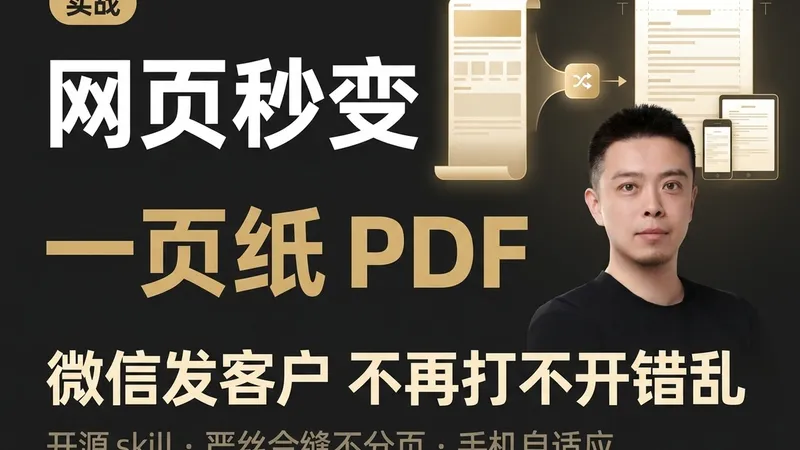
A Web Page to a One-Page PDF in Seconds—I Open-Sourced the Skill
Having AI generate a beautiful web page as your deliverable is popular right now, but send it to a client over a chat app and it often won't open, or opens with the layout wrecked. Print it to PDF and A4 pagination chops it into disconnected slices. This episode shares an open-source skill that measures the page's real width and height, generates a pixel-tight one-page PDF, trims the white margins, and swaps frosted-glass translucency for real colors. Opens on a phone or tablet with the width auto-fitted.

Making Claude Code My Head of Growth—Handing It a Month of Cross-Platform Data
Nearly a month of daily posting, 32 videos, over ten thousand new followers across all platforms. This episode I dump the backend data from five platforms into Claude Code and let it act as my "head of growth" for a full review—merge everything into one master table, dig into completion rate and follower growth platform by platform, find the real reason each video did well or badly, then hand me an immediately actionable optimization checklist per platform. And it remembers all of it, iterating automatically on the next episode's publishing run.

No Designer Needed—Making a Professional Poster with Claude Code
Most people assume Claude Code can only write code and can't make images. This episode walks the whole thing end to end—using it to make a professional invitation poster for an in-person talk. The trick isn't tossing out "make me a poster" and waiting. It's treating Claude Code as a design partner you talk things through with. Give it the context, the reference styles, your own headshot; let it draft the copy first, then have it call GPT Image 2 to render a finished 4K image. Once the style is locked, turn it into a reusable skill—and you can even make the poster move.

Top-Tier AI, Information Parity for Health—Managing My Own Health with Claude Code
A lot of people ask me what an agent as expensive as Claude Code is actually good for beyond making money in your business. This episode is one answer—I use it to manage my own health. I spent two years running a "personal physician for entrepreneurs" business, and now I feed my genome sequencing, years of checkup results, and my full symptom-and-medication history into Claude Code. It's wired into the PubMed research API, and it built me a six-month follow-up plan where every single line traces back to a source.

You Don't Need to Code to Follow These Words—A Tech Glossary for Vibe Coders
Hu Yanbin's app got dismissed by a senior engineer as a toy vibed together by someone who can't code, and I posted a video about it. A comment on that video woke me up—the real blind spot for people who don't code isn't that they can't write code, it's that they don't know the basic concepts, so they don't know what to ask the AI. So I compiled about 122 technical terms that come up most often, explained in plain language—enough to let you ask the right questions while building.

The Complete Claude Code Slash Command Atlas (91 Commands, Beginner-Friendly)
I had Claude Code compile every slash command in the latest build as of today into an atlas a beginner can follow—91 commands, each one explaining what headache it actually saves you. This episode makes one point clear—you don't need to memorize them. For many of them you just talk to it in plain language and it calls them itself; only a handful are worth typing the slash for.

Always Use the Best Model—My API Model Roster (Which Third-Party Models I've Wired into Claude Code)
A lot of people ask me which models my Claude Code is actually connected to, and how it manages to do so much. So this episode I had Claude Code compile every third-party model I access via API into one roster—name, signup URL, use case, and price. My rule is one sentence—always use the best model plus the best tools. Claude is the brain, and for each domain I call whatever is strongest or best value there. Text, image, voice, digital avatars, one by one.

Adapting a Literary Classic for Screen, with AI Writing the Pitch—Turning *The Age of Goodbyes* into a Platform Proposal with Claude Code
The Malaysian film A Love Letter to Grandma is about to open, which reminded me of a landmark work of Malaysian Chinese literature—Li Zishu's novel The Age of Goodbyes. As someone who has made pitch documents for a living, I wondered how I would build the pitch if it were adapted into a series. In this episode I walk the whole thing through with Claude Code—multi-agent research, benchmark titles, casting, marketing—then distill my own hard-won pitch-document experience into a skill and produce a pitch that holds up against professional standards.

Hu Yanbin's App Got Picked Apart, AI Patched the Security Back—A Pre-Launch Security Audit Handbook for People Who Don't Code
Hu Yanbin built an app, and a senior engineer formerly at NetEase wrote a piece pulling out a pile of security problems. My take is that the sourness was unnecessary—products built by people who understand the business fit user needs better, and those security holes can now be patched in a single pass with Claude Code. In this episode I hand that article to Claude Code, have it run a multi-agent team, and produce a pre-launch security audit handbook covering 12 domains and 88 items.

Human-Sounding Voiceover with Claude Code—MiniMax Voice Cloning + a Script Methodology
The narration in my videos isn't me reading into a mic. I cloned my own voice and had Claude Code call MiniMax's TTS to perform it—breaths, sibilance, natural pauses. But the real key isn't the API, it's how you prepare the script—pauses, emotion, embedded tags, homographs, digits spelled out. None of that comes from the docs; it's what I learned from using it daily.

Stop AI Code Changes From Blowing Up—One change-workflow Config
Add one rules config to Claude Code and AI stops blowing up your codebase. Small changes no longer trigger a full ceremony, and changes that touch half the system no longer get hacked in and break things. How much care a change deserves isn't about how hard it is. It's two things—how clear you are before you start (uncertainty), and how much a mistake costs (risk).

Building a Complete Client Proposal with Claude Code
After the last episode on making PPTs with AI, the question I got most was how to build a proposal that's genuinely complete and ready to hand a client. This episode uses a real client workshop to walk the whole pipeline—multi-agent research, cross review, outline, then calling GPT image 2 to generate the pages.

The Dreame Universe—Investment Due Diligence Written by AI
Doing research with Claude Code is already easy, but there's one gap—a lot of information isn't public and can't be found on the web. Close that gap and AI can produce a due diligence report at the level of a veteran investor.

PPVI—Getting Claude Code to Build Web Pages with Real Taste
Claude Code already designs well out of the box, but its default output has the generic AI look. Add a layer of your own visual framework—PPVI—and every page gets an identity.

Voice DNA—Distilling a Creator's Style of Expression
Hand a creator's hit articles straight to an AI to imitate and what comes back reads like someone reciting a script. Try it the other way around: break down how they talk into a written spec for their language style, then use that spec to guide the AI's writing.

Claude Code Memory Management—The 200-Line Ceiling and Memory Rot
Claude Code's memory index has a 200-line ceiling, and anything past it never gets read. So how do you deal with overflow, contamination, and staleness? Isolate with folders, so every project gets its own 200 lines.

Our Claude Code Is Different—Same Horse, Different Harness
The model is just the horse; the harness is what makes it run where you want. 19 rules, 23 hooks, memory organized by category—the config system behind one person developing many projects.

What to Do When the Model Degrades—4 AIs Review Each Other, a 5th Rules on It
Claude Code tells you "fixed," you run it, still broken. So I built a skill called the LLM council. Four vendors each send an AI onto the field, plus a cross-vendor blind judge, aimed squarely at the bugs Claude Code can't solve on its own.

Our Claude Code Is Different—The Truth About Three Ways In
90% of the creators online teaching Claude Code aren't teaching the real Claude Code at all. The real differences between the three ways in (official subscription / official API / relay account pools)—can't do the work, no memory, models swapped out, data stolen, and the April 4 cutoff.

Four Steps to Stop Getting Claude Code Banned—Four Clean Identity Baselines
Fifteen $200 Claude Code Pro Max accounts banned in the three months since Spring Festival. Testing one variable at a time showed that everything the internet tells you—warming up accounts, disabling telemetry—is placebo. What works is four clean identity baselines: a clean residential IP, a clean fingerprint browser, a clean domain mailbox, and a clean 3DS bank card.

The Three-Layer Dividend of the One-Person Company—an OPC Roundtable Talk
I sat on a roundtable today. The topic was the one-person company, and I've run mine for 8 years. I go through the four-part OPC dividend in the AI era (cost / talent / competition / productization), then lay out the three layers for choosing what to work on (genius tier / certain money / interest tier). Three real cases—embroidery pattern software, used-guitar authentication, and five days and nights straight on Claude Code.

AI Makes My Videos—Once I've Said It, It's Done
Friends keep asking how I ship a ten-to-twenty-minute video every single day while running this many projects, working flat out, and traveling constantly. Here's the whole post-production line, opened up—OBS screen recording, a speed-up pass in CapCut, and Claude Code taking over everything after that: transcript, burned-in subtitles, four cover ratios, copy for five platforms.

AI Wins Me the Deal—One Client Interview, a Full Proposal in a Dozen-Odd Minutes
Whether you're a million-a-year executive, a one-person company, or a founder, nothing in daily business is more of a headache than client meetings, sorting out requirements, and writing proposals. Here's how one Singapore client interview becomes a complete business canvas + personal brand positioning + creator-business topic plan in a dozen-odd minutes, using Gemini 3 Flash plus my business canvas skill in Claude Code.

A Personal Blog Built with Claude Code—An Ad Guy Who Let AI Write All the Code
My digital avatar's usage has spiked past what I can afford to keep paying for, so it has to go offline. Meanwhile friends keep telling me the videos run too long and they want a text version. Two things at once—so let's just build a blog. I give the requirements, Claude Code does the work, and I never look at a single line of code.

Building a Voice Input Method Without Writing Code—One Ad Guy's Complete Product Thinking
I'm an advertising guy and I can't write a line of code. I still shipped a commercial Windows voice input method. Claude Code handles execution; I only handle thinking it through and deciding. The complete product thinking, in one continuous take.
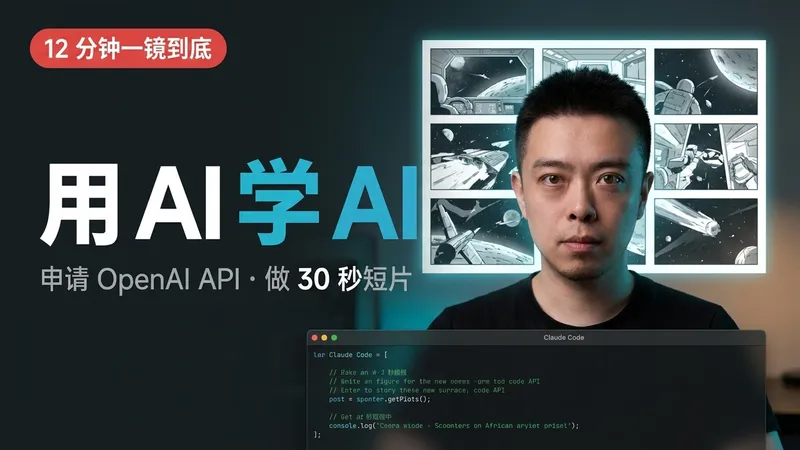
Learning AI with AI—GPT image2 in 12 Minutes, One Continuous Take
My friends at big companies have bosses pushing them to use AI, and the news-cycle AI creators only make people more anxious. So I took a different route—I put Claude Code in the teacher's seat and ran GPT image2 from storyboard to a 30-second sci-fi short in one continuous take.

Using AI to Build a Talk—Deck, Full Transcript, and 13 Voiceover Clips in 30 Minutes
Every pitch I've given in the past year has used an AI-generated deck, an AI-written transcript, and voiceover cloned from my own voice. One listen before bed, one listen on a run, and by the time I'm on stage I know it well enough to speak along with the AI.

A 10-Year-Old Air Mouse | Directing Claude Code from the Couch to Dig Up 7 Schools of AI Creators
Voice already drives most of my AI work, but pressing 1234, arrowing through options, and hitting Enter to confirm aren't going anywhere. Getting up off the couch is too much trouble, and the cure turned out to be a decade-old gadget—the air mouse.

An AI Checkup for Your PC—30+ Windows Bottlenecks Scanned in 5 Minutes
Treating Claude Code as a coding tool sells it short. I put it to work as my computer doctor—full diagnostic sweep, multi-agent concurrent research, execution split across three conversations, and an auto-generated HTML to-do list.

AI Contract Review—How a One-Person Company Reviews a 30-Page Cross-Border Bilingual Contract
The most painful part of running a one-person company isn't making money. It's the helplessness of staring at a 30-page cross-border bilingual contract. A specialist lawyer runs over ¥10,000 a contract and every round of feedback takes hours. So I built and polished an AI legal agent—review report in 15 minutes.

An AI Subtitle Workflow—No Subtitles on US Netflix? Let Claude Code Make Me a Set
The 2018 sci-fi film *Anon* has no simplified Chinese subtitles on US Netflix. Multi-agent concurrent research to find an extension, find the original track, do the translation. Claude refused a full translation on copyright grounds—so I changed approach and had a watchable version in 10 minutes.

Gene-Level AI Health Management—A Few Hundred Yuan of Genetic Data + AI = Personal Physician Parity
A full genetic report I paid a few hundred yuan for over a decade ago, 1.2 million rows of data sitting on a hard drive that nobody could read. I had AI run through it, and what came back wasn't generic advice but precision down to drug metabolism, workout timing, and supplement dosages.

AI E-Commerce Photography—A Workbench Built by a One-Person Company, Four Libraries and One Click
Half a month of polishing with a designer friend. Upload one street-style shot and the style, scene, model, and individual products all get pulled out automatically—then pick your lighting and focal length and composite in one click. Nano Banana 2 nails character consistency, GPT Image nails logo detail.

AI Deep Research—Turning a One-Line Request into a 47-Tablet Comparison in 14 Minutes
I needed a new tablet for remote desktop work. I didn't ask the AI to "recommend one"—I asked it for a click-to-sort comparison table. Five sentences of requirements in, 47 rows out, with three clarifying questions and 14 minutes of research in between.

CrunaStudio's First Full Demo—A Year of Building Industrialized AI Comic Drama
Drop in a 19,000-word novel, get back an 80-episode script, character assets, and copyright-clear music. I hadn't shipped a single product video in a year—today I ran the whole pipeline in one continuous take.
No matches. Try another keyword, or .